

The first generation of AI agents in investment management today are good at synthesizing information, but poor at understanding it. They can pull a filing, summarize a DDQ, or draft a meeting summary, but they cannot suggest judgments characterized by the way your firm sees the world. That judgment lives in a capability that most firms do not yet have: the cognitive layer.
The cognitive layer is where agents stop being efficiency clerks and start reasoning like experienced professionals. It encapsulates industry best practice, the firm’s proprietary knowledge, and the specific preferences of the receivers of the output. Firms that fold this layer in will get compounding returns from agentic AI; firms that do not will keep looking for (and trying to buy) faster ways to produce first drafts.
Task-level AI has hit its ceiling
The industry needs more than incremental efficiency. Boston Consulting Group reports that asset management AUM grew 11% to $147 trillion in 2025, but more than 80% of revenue growth came from market performance. Fees keep compressing, and costs have outpaced revenues for the last 15 years.
Generic generative AI has helped at the margins – analysts summarize filings faster; relationship managers draft emails faster – but humans still gather the inputs, move between systems, check the outputs, and assemble the final work. Access to capable models is now table stakes, but as Chris Perry recently noted in Forbes, the operational layer on top of model access is what will vault AI usage into producing gains for the bottom line.
The missing piece is not more intelligence. It is judgment: the ability to interpret data in context, prioritize what matters, and anticipate how a decision-maker will react. That is what a cognitive layer supplies.
The three layers of an agentic system
A well-built agentic platform separates the work into three layers. Each builds on the one before it, and the value peaks with the cognitive layer.
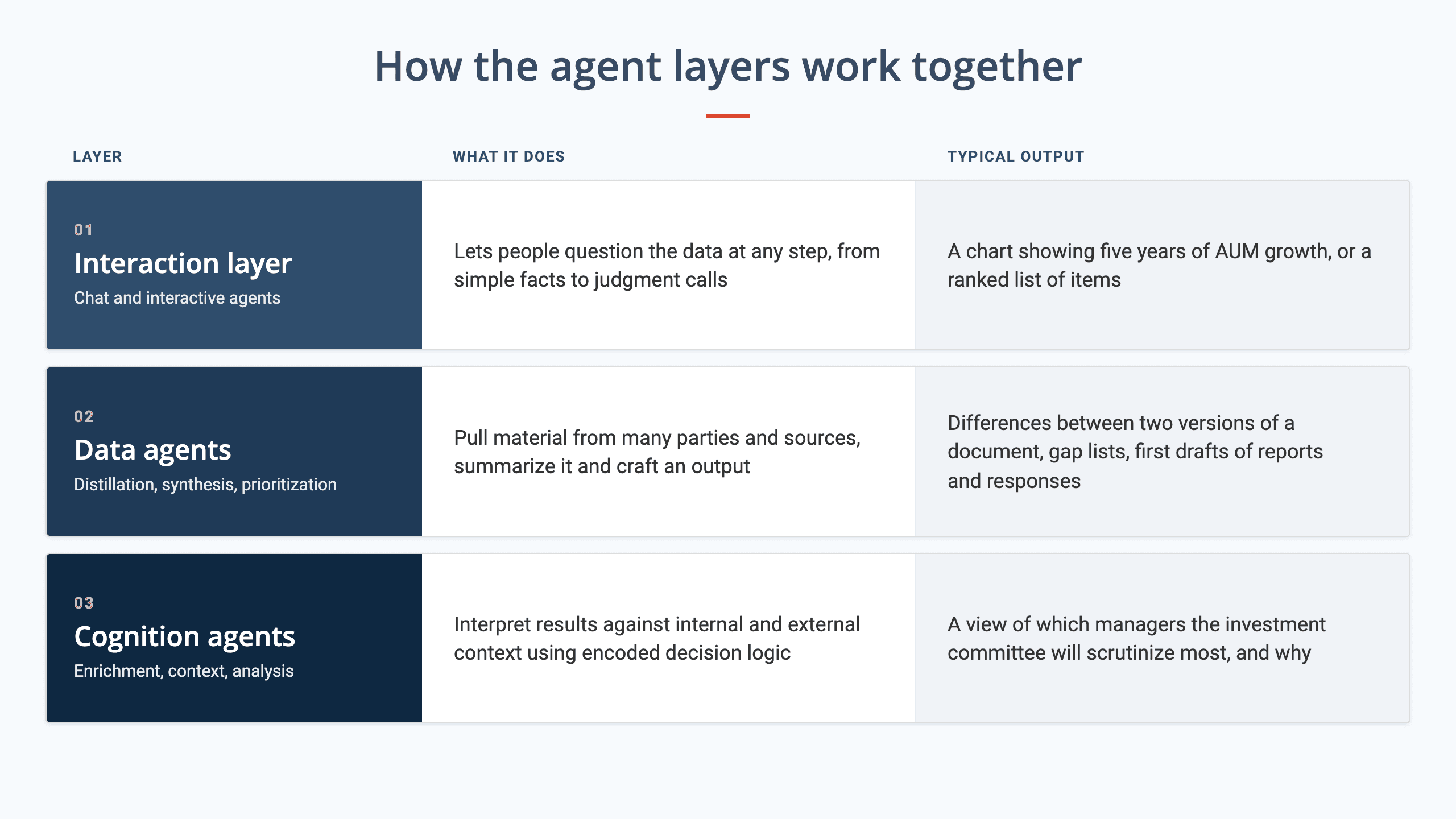
Everyone has access to the first layer. Many firms have invested in the middle, and there is no doubt that data agents are valuable: they can turn thousands of pages into a manageable set of findings. But distilled data is still just data. The cognitive layer is the firm’s “brain,” and it draws on three sources:
- Industry best practice. Regulatory frameworks, analytical standards, and the accumulated expertise of people who have done the work for decades.
- Proprietary knowledge. The firm’s own history, prior decisions, internal analyses, and institutional memory.
- Audience preferences. What a specific board, committee, or client cares about, has asked before, and is likely to press on next.
The difference shows up in the questions people can ask. A data layer answers factual queries, such as “give me a chart showing the annual AUM of a manager over the last 5 years”. A cognitive layer answers judgment queries, such as “given the latest updated information, which managers should the investment committee worry about given this quarter’s changes”.
Case in point: manager research
Manager research shows why the cognitive layer matters. Data agents can assist with the first part of the process, but cognitive agents take it to the next level by judging what has changed and whether it matters.
Gather. Researchers must collect DDQs, pitch books, holdings, performance data, regulatory filings, and meeting notes for every manager they cover. Data agents can assemble these materials from managers, internal systems, and third-party sources.
Compare. Data agents can compare this material to data from prior periods to surface material changes such as team departures, strategy drift, asset shifts, or new operational providers.
Analyze. But that’s where data agents end. Cognition agents can assess each change against your diligence framework and the investment committee’s known concerns, score the risk, and anticipate the questions the committee will ask.
Report. Agents draft investment committee memos and monitoring reports with a clear recommendation and the evidence behind it.
The payoff is coverage and quality together. BCG estimates an AI-first asset manager could expand research coverage by two to five times, and Analysts can spend their time testing conclusions instead of contrasting inputs. Only the cognitive layer makes steps three and four possible; the rest is faster paperwork. When you factor in that operational, legal, and compliance teams each add more parties and more documents, the gains can be asymptotic.
The same pattern across the firm
Manager research is one example of a broader pattern. Wherever work combines heavy data gathering with expert judgment, the cognitive layer turns task automation into workflow redesign.
Investor meeting preparation. Agents combine CRM history, meeting notes, public filings, portfolio data, and media coverage into a tailored brief with likely questions and talking points.
Fund board reviews. In the annual 15(c) advisory contract review, agents aggregate materials, compare board books year over year, score funds on the Gartenberg factors, and draft management’s response.
Distribution. Agents analyze client activity, portfolio needs, and approved product content to surface opportunities and personalize outreach. BCG projects five to ten times greater RFP capacity and three to five times more client coverage per relationship manager when a proper agentic framework is put to work – which yields revenue growth.
Operations. Agents execute repeatable steps in onboarding, reconciliations, reporting, guideline monitoring, and document review. People can shift their focus to managing exceptions, making higher-risk decisions, and applying complex judgment.
In each case, data agents gather, and cognition agents interpret. Build the cognitive layer once, and every new workflow inherits its context instead of starting from scratch.
A brain needs guardrails
The more judgment agents exercise, the more governance matters. In a regulated, multi-party process, a cognitive layer has to be built on three principles:
Organized. An administrator controls both data access and agent creation. That structure matters when many disciplines and outside parties collaborate, and it prevents uncontrolled inputs and agent sprawl. Every agent has an identified owner.
Secure. Client data sits in a ring-fenced, client-specific environment, is never used to train public models, and is permissioned at the user level.
Traceable. The whole process is auditable: the inputs used, how they were processed, the conclusions drawn, who did what, and every communication along the way.
Traceability is what makes cognition agents trustworthy. For example, when an agent flags the team turnover at a manager as a material risk, reviewers need to see which data fed this decision, the sources of that information, and the decision logic that led there.
Work then falls into three categories: AI-autonomous, AI-augmented, and human-led. Regulated, strategic, and client-facing decisions, such as hiring or terminating a manager, stay firmly with people. The cognitive layer prepares them better; it does not decide for them.
How to start building it
Becoming AI-first is not about giving every employee a chatbot. It means choosing two or three high-value workflows and redesigning them end to end on a shared cognitive layer, so that each new workflow makes the next one easier.
Pick workflows with heavy manual effort and strategic weight. Research, manager diligence, investor meeting preparation, RFP response, and reporting are natural starting points.
Connect trusted data first. CRM, portfolio, document, and research systems should feed the layer, so agents reason from the firm’s own facts.
Assign an owner and define the governance. Each workflow needs a named owner, clear permissions, and explicit human review points.
Measure business outcomes. Track coverage, cycle time, capacity, and quality, not just usage.
AI domain expertise is the hardest part to build. Partnering with an AI-first technology provider is often the most logical route. The decision logic in cognition agents should be designed by people who know the industry and processes deeply, with the ability to configure to each client’s or board’s preferences. Pre-built agents plus targeted customization will get a firm further, faster, compared to generic model usage.
Judgment is the differentiator
Every firm will soon have agents that can read, summarize, and draft. Few will have agents that understand what their boards, clients, and investment committees actually care about. That understanding is the cognitive layer: industry expertise, proprietary knowledge, and audience context, encoded into agents and governed from the ground up.
Agentic AI will not replace the expertise at the center of investment management; it will amplify it. The firms that lead will utilize the cognitive layer that turns fragmented information into intelligence, intelligence into action, and action into scalable business value.